Can You Clean Plastics, Rubber, and Multi-Material Assemblies Safely?
Table of Contents
- How Ultrasonic Energy Interacts With Plastics and Rubber
- Material-Specific Considerations
- Multi-Material Assembly Risks
- Process Parameters That Reduce Risk
- Validation and Inspection
- Quick Compatibility Check
- Contact GTKCLEAN for a Compatibility Review
- Frequently Asked Questions
- Can ultrasonic cleaning damage plastic parts?
- What frequency should I use for plastic and rubber assemblies?
- How do I validate a cleaning process for multi-material parts?
- Can metal, plastic, and rubber be cleaned in the same bath?
- References
Yes, but only when the cleaning process is designed around the least-compatible material in the part, not the metal component. Many parts-cleaning operations run ultrasonic or spray processes successfully on plastic housings, rubber seals, and assemblies that combine polymers with metals, ceramics, or glass. The challenge is not whether these materials can be cleaned; it is how cavitation, heat, chemical exposure, and drying stress affect each material phase. This guide explains the failure modes to watch, how to set conservative starting parameters, and how to validate a process before full production.
How Ultrasonic Energy Interacts With Plastics and Rubber
Ultrasonic cleaning relies on cavitation bubbles that form and collapse in the cleaning liquid. On rigid metal surfaces, bubble collapse is sharply focused and removes oil, chips, and particulate efficiently. On softer polymer surfaces, some of that mechanical energy is absorbed, so the cleaning effect can be less uniform and the thermal effect can be more localized at the surface. Plastics and rubber also interact with the cleaning chemistry differently from metals. They can absorb water or solvent, lose plasticizer, swell, craze, or develop microcracks. The material’s response depends less on whether cavitation is present and more on frequency, temperature, cycle time, detergent type, and part geometry [1], [2].
Material-Specific Considerations
Each polymer family has distinct failure modes in a cleaning bath. A part that is simply described as “plastic” does not provide enough information for process design. The table below groups common materials and the risks to address.
| Material family | Common failure modes | Conservative approach |
|---|---|---|
| Semi-crystalline plastics such as PE, PP, POM, and nylon | Softening, swelling, stress cracking | Mild aqueous detergent; moderate temperature; avoid strong solvent degreasers unless tested |
| Amorphous plastics such as PC, PMMA, ABS, and PSU | Crazing, microcracking, adhesive bond attack | Shorter cycles; gentle cavitation; avoid solvent-based prewash |
| Rubber and elastomers such as NBR, EPDM, FKM, and silicone | Swelling, seal lip damage, compression set | Test each compound; limit exposure time; verify dimensions and hardness after cleaning |
| Multi-material assemblies | Crevice retention, differential expansion, metal-polymer interface attack | Stage aggressive cleaning away from sensitive polymer phases; controlled rinse and drying |
For rubber components, ISO 1817 describes immersion testing for mass, volume, and hardness change after exposure to liquids [3]. This type of data should guide detergent selection before a full assembly is committed to a production cleaning process.
Multi-Material Assembly Risks
The more serious failure modes occur when a rigid metal insert is bonded, threaded, or overmolded into a polymer body. The metal surface sees strongly focused cavitation, while the adjacent polymer may absorb energy unevenly. A cleaning solution that is safe for the metal may attack the polymer phase, and a solvent that is acceptable for a seal may extract plasticizer or weaken an adhesive bond. Crevices at the metal-polymer interface can retain fluid after rinsing, which leads to residue, corrosion, or later outgassing. Assemblies with blind holes, O-ring grooves, or threaded inserts require longer rinse cycles and stronger drying because capillary retention resists removal.
Multi-material assemblies fail most often when the cleaning process is optimized for the metal component and the polymer is treated as an afterthought.
(https://txt.gtkclean.com/multi-tank-ultrasonic-cleaning-a-deep-dive-into-industrial-configurations/) covers how staged tanks separate aggressive degreasing from gentle rinsing for mixed-material loads.
Process Parameters That Reduce Risk
When a mixed-material basket needs to be cleaned in a single system, set the process around the most sensitive polymer in the load. Choose the highest ultrasonic frequency that still removes the target soil. Higher-frequency operation generally produces smaller cavitation bubbles and lower mechanical impact on soft surfaces; lower-frequency operation may be required for heavy metal soil but raises the risk of polymer surface damage. If heavy metal contamination and sensitive plastics both appear in the same basket, stage the work: run an aggressive preclean on metal-dominated parts before a gentler ultrasonic finishing stage for the complete assembly.
Temperature is another variable that needs to be controlled carefully. A detergent supplier may recommend a temperature that is effective on cutting oils but too high for an amorphous plastic or a low-durometer elastomer. Start at the lower end of the detergent’s recommended range for polymer-rich loads, and increase only after the part passes dimensional and visual inspection. Drying is equally important: trapped rinse water in a plastic-metal interface can cause staining, residue, or corrosion, so air-knife, vacuum, or hot-air drying should be selected with the assembly geometry in mind.
For example, a glass-filled nylon manifold with EPDM seals and stainless-steel inserts may clean acceptably with a higher-frequency cycle and mild aqueous detergent, but show seal-edge cracking under a lower-frequency heavy-soil recipe. Running a small validation batch before committing the production fixture is the reliable way to separate process effect from material limit.
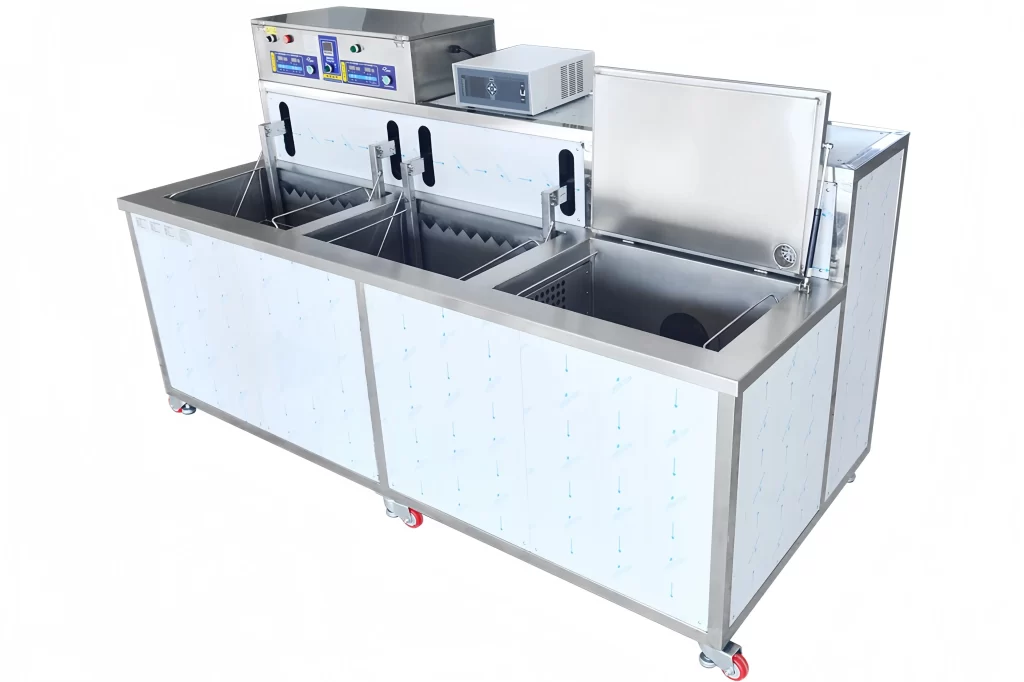
Low-frequency cavitation removes heavy soil from metal but can be too aggressive for polymer seats and thin elastomer lips.
(https://txt.gtkclean.com/ultrasonic-cleaning-process-a-step-by-step-technical-guide/) covers how frequency, temperature, and cycle time should be matched to the least-compatible material in the basket.
Validation and Inspection
Material compatibility should be proven before the cleaning process is approved. Coupon testing according to ASTM D543 [1] for plastics and ISO 175 [2] for chemical immersion provides a controlled baseline. For rubber components, ISO 1817 [3] describes the effect of liquids on vulcanized or thermoplastic rubber, including change in mass, volume, and hardness. For assemblies that must meet a particulate cleanliness target, ISO 16232 [4] defines extraction and counting methods that help distinguish particulate release from surface damage.
Inspection should include visual checks for crazing, haze, blistering, and dimensional change. Hardness testing and weight change after a standard immersion period are useful for seals. A short production trial should compare reject rates before and after cleaning, not just visual appearance, because a polymer can look acceptable after cleaning but fail later due to residual chemical attack.
Once a process is qualified on test coupons, the same logic applies to full baskets and final cleanliness limits.
(https://txt.gtkclean.com/precision-parts-cleaning-standards-an-expert-guide-to-industrial-cleanliness/) covers how to define cleanliness limits and test methods without over-cleaning sensitive materials.
Quick Compatibility Check
If you are preparing a mixed-material basket, start with material datasheets and known failure modes. Run a small coupon test with the intended detergent, temperature, frequency, and drying method. Measure dimensions and hardness before and after the cycle. If the polymer phase shows swelling, cracking, haze, or weight change, adjust the cycle or consult an applications engineer. For a free parameter review, send part drawings, material grades, and the current cleanliness specification to [email protected] or call +86 17768507147.
Contact GTKCLEAN for a Compatibility Review
GTKCLEAN designs multi-stage ultrasonic, solvent, and conveyor cleaning systems for parts that combine metals, plastics, rubber, and coated surfaces. Send part drawings, material declarations, and your target cleanliness limit to [email protected] or contact Li Hao at +86 17768507147. The application team can recommend frequency, chemistry, fixture design, drying method, and stage sequence for a mixed-material load without putting production parts at risk.
Frequently Asked Questions
Can ultrasonic cleaning damage plastic parts?
Yes, it can, but damage is usually the result of mismatched parameters rather than ultrasonic cleaning itself. Aggressive chemistry, high temperature, lower-frequency cavitation, or excessive cycle time can soften, craze, or crack a polymer. With a compatible detergent and tuned cycle, many plastics clean successfully.
What frequency should I use for plastic and rubber assemblies?
Start with a higher-frequency setting on the ultrasonic generator. Higher-frequency operation generally produces smaller cavitation bubbles and less mechanical impact on soft materials. Lower-frequency operation is usually reserved for heavy soils on metal parts. Frequency should still be confirmed with a small validation batch, not assumed from a table.
How do I validate a cleaning process for multi-material parts?
Use material coupon tests, dimensional or hardness measurements, and controlled production trials. Standards such as ASTM D543, ISO 175, ISO 1817, and ISO 16232 provide test frameworks for chemical resistance, elastomer compatibility, and particulate cleanliness [1]–[4].
Can metal, plastic, and rubber be cleaned in the same bath?
It depends on the chemistry and the cycle design. If the detergent is compatible with all phases and the process is staged to protect the polymer, a single system can handle a mixed load. For high-spec or high-risk parts, separate the aggressive metal-cleaning stage from the gentler polymer-cleaning stage, and verify rinse removal and drying for crevices and interfaces.
References
[1] ASTM D543-21, Standard Practices for Evaluating the Resistance of Plastics to Chemical Reagents, ASTM International, West Conshohocken, PA, 2021.
[2] ISO 175:2010, Plastics — Methods of test for the determination of the effects of immersion in liquid chemicals, International Organization for Standardization, Geneva, 2010.
[3] ISO 1817:2015, Rubber, vulcanized or thermoplastic — Determination of the effect of liquids, International Organization for Standardization, Geneva, 2015.
[4] ISO 16232:2018, Road vehicles — Cleanliness of components of fluid circuits, International Organization for Standardization, Geneva, 2018.
If you’re interested, check out these related articles:
What Is The Technical Principle Of Hydrocarbon(Solvent) Cleaning Machines?
Industrial Cleaning Baskets: Why They Matter for Your Parts Washing Efficiency
What Is Ultrasonic Wave?
Industrial Ultrasonic Cleaning Systems: The Complete Guide