How to Clean Copper and Brass Without Tarnish or Discoloration
Table of Contents
- Why Copper and Brass Discolor During Cleaning
- Cleaning Chemistry for Copper-Base Alloys
- Ultrasonic Parameters That Protect Soft Yellow Metals
- Rinsing, Inhibiting, and Drying to a Tarnish-Free Finish
- Troubleshooting Discoloration After Ultrasonic Cleaning
- Cleaning Process Review for Copper and Brass Parts
- Frequently Asked Questions
- Can copper and brass be cleaned in the same ultrasonic bath?
- What pH is safe for brass?
- Does ultrasonic cleaning itself tarnish brass?
- What frequency is best for copper and brass?
- How do we fix brass that is already discolored?
- Can we use vinegar or lemon juice to clean brass?
- References
Copper and brass clean beautifully in ultrasonic systems — until the wrong detergent, aggressive cavitation, or an unfiltered final rinse turns a bright machined part into a spotted, tarnished lot. The Copper Development Association cautions that copper-base alloys are sensitive to ammonia, strong acid, and chloride-rich media, so a chemistry chosen for steel can become the source of the discoloration problem it was meant to fix [1]. Brass is a copper-zinc alloy, and zinc responds differently from copper to heat, alkalinity, and acid. A reliable copper and brass process therefore controls four variables at the same time: chemistry, ultrasonic energy, rinse quality, and drying speed. This guide explains each variable and how to combine them in a production-robust cleaning line.
Why Copper and Brass Discolor During Cleaning
Discoloration on copper and brass comes from three families of surface change: oxide growth, selective metal removal, and residues drying on the surface. The base oxide on copper is cuprous oxide, which shifts from a transparent film toward brown as thickness increases; heat and residual alkalinity speed that shift [2]. Because tarnish severity can be graded, copper-strip corrosion testing such as ASTM D130 gives a numerical reference for what “unacceptable discoloration” means in a specification [3].
Brass adds selective dissolution. In media that are strongly acidic or strongly alkaline without inhibitors, zinc leaches preferentially and leaves a copper-rich, pink surface — a condition called dezincification [4]. Wrought grades such as C260 cartridge brass and C360 free-cutting brass are covered by ASTM B36/B36M, which sets composition limits that help you identify which brass you are processing [5]. Pink material loss is often mistaken for staining, but it cannot be wiped off.
Cleaning Chemistry for Copper-Base Alloys
The first chemistry rule is to avoid ammonia, amines, and chloride-bearing additives on copper and brass. Ammoniated cleaners complex copper and can etch bright surfaces, while chlorides promote localized attack [1]. If a steel-formulated alkaline soak is already in the plant, do not assume it transfers to yellow metals; confirm the formulation with the chemical supplier and, where possible, run an ASTM D130 copper-strip exposure on a polished coupon before production [3].
In practice, copper and brass run best in a non-ammoniated, neutral-to-mildly-alkaline cleaner formulated for yellow metals. The bath stays below the strongly alkaline range where dezincification accelerates and above the acid range where zinc dissolves rapidly [4]. For oxide and tarnish removal on a bright surface, a short, buffered citric-based acid with a brass-safe inhibitor is preferred over mineral acids, and any acid stage must be followed by a complete rinse before drying.
A single detergent rarely fits every copper alloy, because the ratio of contaminant to base metal changes with forming, machining, and heat-treat history. If bright finish is failing in blind holes, threads, or small internal features, send the part drawing and current process to [email protected] or call +86 17768507147. The GTKCLEAN engineering team reviews detergent, rinse cascade, and stage sequence against the specific alloy. A full inquiry list is provided at the end of this article.
Ultrasonic Parameters That Protect Soft Yellow Metals
Ultrasonic cleaning removes soil through cavitation, but the same collapsing bubbles can pit a soft copper or brass surface when energy is concentrated. For yellow metals, 40 kHz or sweep-frequency generators are gentler than long dwell at 25 kHz; smaller bubble size at higher frequency produces more uniform surface action. Lower frequencies remain useful for heavy soil on robust parts, but on decorative or tight-tolerance copper alloys they raise the risk of cavitation erosion.
Cavitation energy concentrates near low frequencies and distributes more gently at higher frequencies, so substrate selection matters as much as soil removal. <Optimize Ultrasonic Frequency for Diverse Materials> covers frequency selection by material so the cleaning action matches soft copper and brass.
Power density is the second lever. Copper and brass need enough ultrasonic power to remove cutting fluid and light oxide, but not so much that the surface frosts. Power should sit at the low end of the usable cleaning window, with cycle time extended in small increments only after a coupon test. Bath temperature is commonly held at 40–50 °C in copper-alloy processes: enough heat to lower oil viscosity, below the range where cuprous oxide growth accelerates [2].
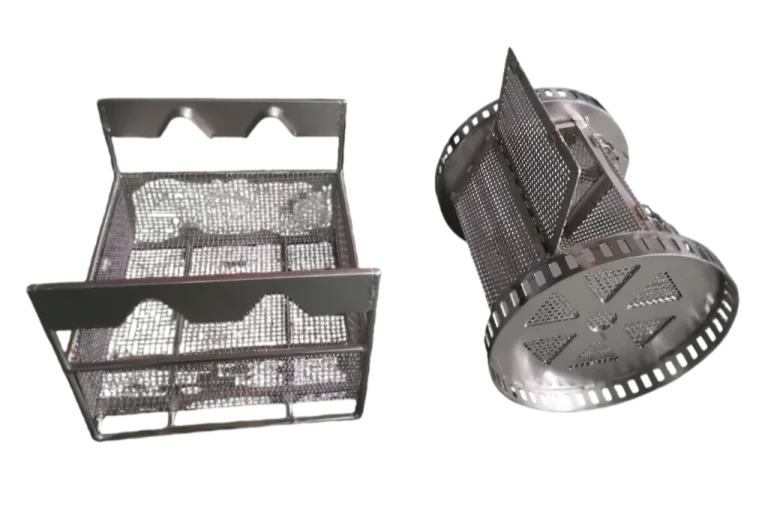
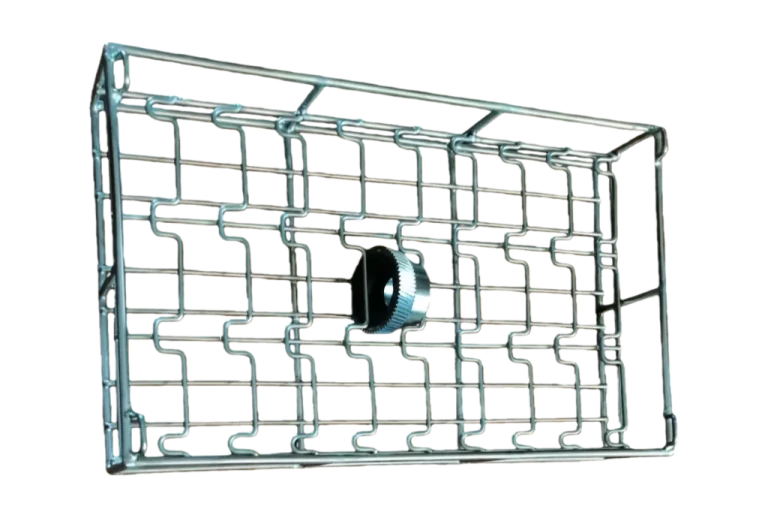
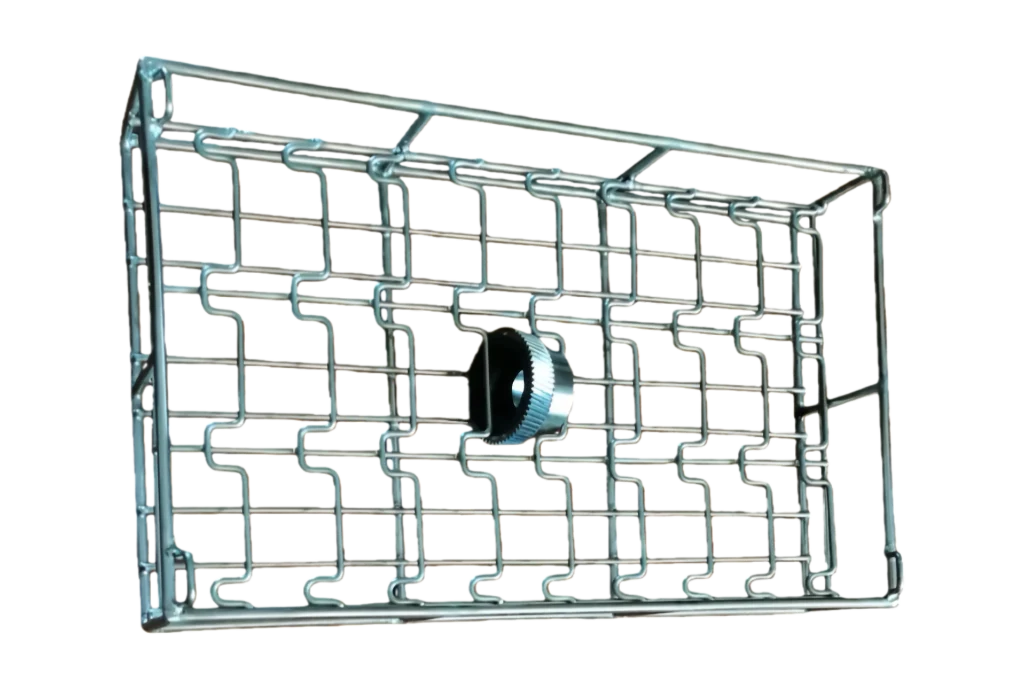
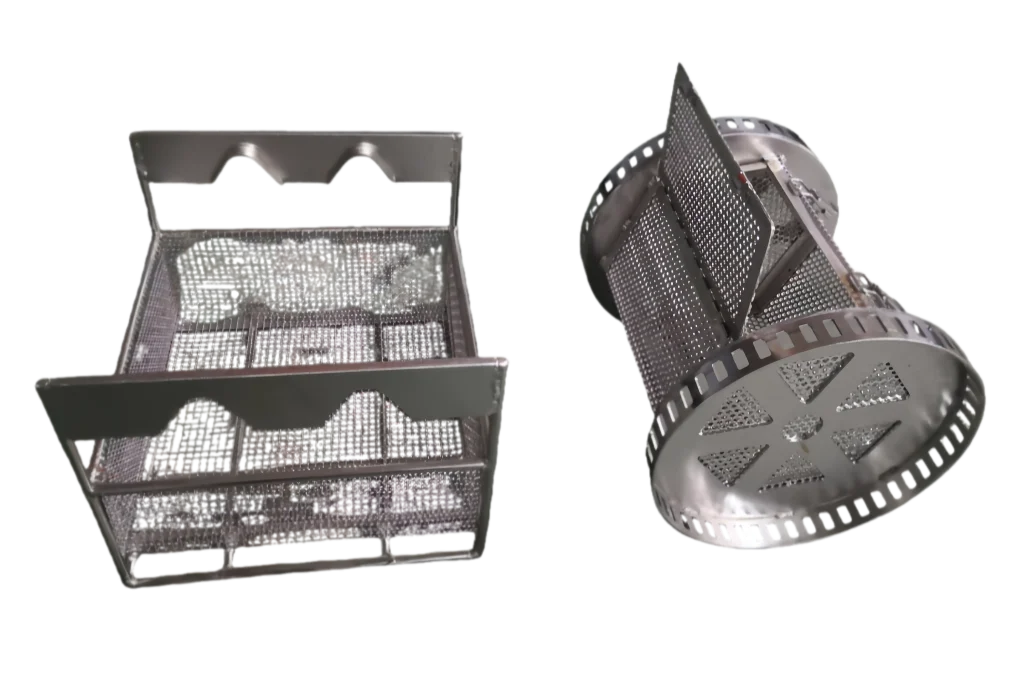
Fixturing matters as much as generator settings. Parts must be spaced so they do not touch, because part-on-part contact shadows cavitation on one side and creates dark contact marks. Baskets with dedicated pockets or dividers keep thin brass stampings separated, and rotary baskets keep blind holes and recesses facing the bath rather than trapping air.
Rinsing, Inhibiting, and Drying to a Tarnish-Free Finish
Discoloration often appears after the wash, during rinsing and waiting. The wash step must be followed by a cascade rinse that removes the detergent film before it dries, and the final rinse should be high-purity DI water — near 0.05–0.1 µS/cm — so no mineral residue remains to form white spots. A final corrosion-inhibiting dip, matched to the detergent chemistry, leaves a temporary protective layer that holds brightness until the next operation.
Stage order matters because liquid films left between wash and drying are where spotting and tarnish begin. <Ultrasonic Cleaning Process: A Step by Step Technical Guide> covers the stage-by-stage flow for precision metals, including rinse placement and inhibitor steps.
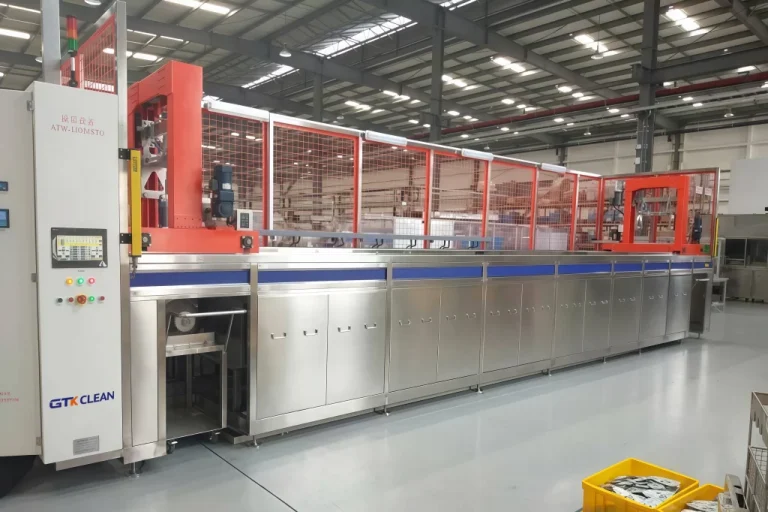
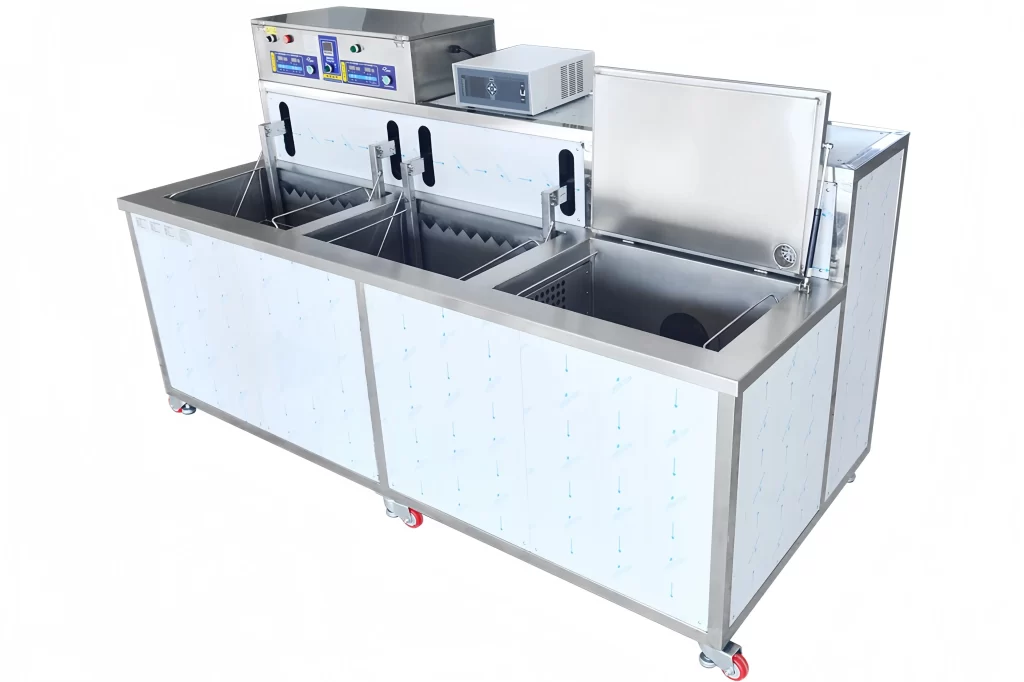
After the final rinse, copper and brass should dry quickly. Hot-air or vacuum drying is specified rather than slow ambient air-dry, because residual water on a clean copper surface creates localized oxidation cells. Multi-tank systems that combine ultrasonic wash, cascade DI rinses, an inhibitor dip, and hot-air or vacuum drying shorten the dwell time between stages — which is exactly where discoloration otherwise appears.
Troubleshooting Discoloration After Ultrasonic Cleaning
When a lot comes out discolored even though the recipe looks right, the cause is usually one of a small set of process interactions. The table below lists the discoloration patterns seen most often, the likely mechanism, and the first correction to test.
| Discoloration pattern | Likely cause | First correction |
|---|---|---|
| Brown to black film | Cuprous/cupric oxide growth from heat, residual alkalinity, or wet dwell [2] | Lower bath temperature, shorten cycle, dry immediately after rinse |
| Pink or red surface | Dezincification leaving copper-rich material [4] | Move to a brass-approved, inhibited chemistry; reduce acid or strong alkali exposure |
| White spots / water marks | Mineral residue from hard-water final rinse | Switch final rinse to DI water near 0.05–0.1 µS/cm |
| Frosted or dull etch | Excessive cavitation at low frequency or high power density | Raise frequency to 40 kHz or sweep; reduce power and re-test coupon |
| Green residues | Copper soap formed by fatty-acid detergents, or incomplete rinse | Change to a yellow-metal cleaner; add or improve the rinse cascade |
| Localized dark contact marks | Part-on-part contact shadowing cavitation | Increase spacing or use compartmented/rotary baskets |
| Blue to violet iridescence | Thin oxide interference film from uneven drying or mild heat | Normalize drying speed and bath temperature across the lot |
The two patterns misdiagnosed most often are the pink surface and the frosted etch. Pink is selective metal loss, not a stain, and will not wipe off; frosting is energy-driven material erosion, not a chemistry failure [4]. Evaluating a polished coupon by ASTM D130 before full production gives a numeric baseline, so the first lot off a new line is compared against a standard rather than against memory [3].
Bubble collapse is the cleaning mechanism and the same energy source that damages soft alloys when parameters are too aggressive. <What Is Ultrasonic Cavitation Effect> covers the mechanism behind both soil removal and surface erosion.
Cleaning Process Review for Copper and Brass Parts
The fastest path to correct an existing line, or to specify a new one, is to validate the four variables on a real coupon lot: chemistry, ultrasonic energy, rinse quality, and drying speed. These are reviewed against the alloy grade, part geometry, and the inspection standard the customer must meet.
Send the following to [email protected] or call +86 17768507147:
- Alloy grade or material designation, such as C360 brass or C110 copper
- Part geometry and blind-hole or thread features
- Current detergent and rinse setup, if any
- Finish requirement or acceptance standard for discoloration
- Batch size and required cycle time
GTKCLEAN — Suzhou Grintek Environmental Technology Co., Ltd. — designs automated multi-tank ultrasonic cleaning systems, solvent and aqueous cleaning lines, and water treatment equipment. The engineering team supports process development, on-site installation, and training in more than 20 countries.
Frequently Asked Questions
Can copper and brass be cleaned in the same ultrasonic bath?
They can, provided the alloys respond to the same detergent and are not mixed with ferrous or aluminum parts that could introduce galvanic couples. Because brass contains zinc while pure copper does not, it is safer to separate them during acid-based brightening steps, where the risk of preferential attack differs.
What pH is safe for brass?
For most production cleaning, a non-ammoniated, neutral-to-mildly-alkaline cleaner works best. Strongly acidic media dissolve zinc, and strongly alkaline media can also attack zinc if uninhibited [4]. Acid stages, when used, should be short, buffered, and inhibited, followed immediately by rinsing.
Does ultrasonic cleaning itself tarnish brass?
Ultrasonic energy alone does not create oxide tarnish, but aggressive low-frequency cavitation can frost or etch the surface, and extended exposure in a warm, alkaline bath can promote oxidation [2]. Gentle frequency, moderate temperature, and rapid transfer to the rinse stage remove most of the risk.
What frequency is best for copper and brass?
For most copper and brass parts, 40 kHz or sweep is the preferred setting. Higher frequency produces smaller, less destructive bubbles and a more uniform surface finish. Frequency around 25 kHz is reserved for heavy contamination on robust parts.
How do we fix brass that is already discolored?
If the discoloration is oxide tarnish, a short, inhibited citric-based bright dip can restore brightness, but it must be followed by thorough rinsing, an inhibitor step, and immediate drying. Pink dezincification or frosted cavitation damage is material loss and cannot be reversed chemically; the process parameters must be corrected instead [4].
Can we use vinegar or lemon juice to clean brass?
Household acids remove tarnish, but they leave a reactive, slightly etched surface that re-tarnishes quickly and can accelerate zinc leaching. In production, a formulated, inhibited acid stage with controlled contact time and proper rinsing is more consistent and auditable [4].
References
[1] Copper Development Association Inc., “Cleaning Copper and Copper Alloys,” Copper Alloy Technical Manual, New York, NY.
[2] ASM International, ASM Handbook, Vol. 5: Surface Engineering, 10th ed., Materials Park, OH, 1994.
[3] ASTM International, ASTM D130-19, Standard Test Method for Corrosiveness to Copper from Petroleum Products by Copper Strip Test, West Conshohocken, PA, 2019.
[4] AMPP (formerly NACE International), “Dezincification of Brasses,” Corrosion Basics, Houston, TX.
[5] ASTM International, ASTM B36/B36M-18, Standard Specification for Brass Plate, Sheet, Strip, and Rolled Bar, West Conshohocken, PA, 2018.
If you’re interested, check out these related articles:
Industrial Cleaning System ROI: Calculating Your Investment Return
Choosing the Right Ultrasonic Cleaning System for Industrial Success