How to Clean Aluminum Parts Without Damage: A Technical Guide
Table of Contents
- Why Aluminum Is Damage-Sensitive in Industrial Cleaning
- Choosing a Cleaning Chemistry That Will Not Attack the Base Metal
- Ultrasonic Parameters That Clean Aluminum Without Pitting or Etching
- Rinsing, Drying, and Corrosion Control After Cleaning
- Basket Selection, Fixturing, and Load Placement
- Process Verification and Common Failure Signs
- Engineering Review: Validate Your Aluminum Cleaning Process Before You Scale
- FAQ
- Can I use an alkaline degreaser on aluminum?
- What ultrasonic frequency is safest for aluminum?
- Why does aluminum turn black after cleaning?
- Is it safe to put aluminum parts in a hot-air dryer?
- Can I clean aluminum in a solvent ultrasonic system?
- How do I know if the cleaning process is damaging the aluminum surface?
- References
Aluminum parts fail during cleaning not usually because they are hard to clean, but because they are easy to overprocess. The same alkaline chemistry and aggressive agitation that remove stamping oil, cutting fluid, chips, and fingerprints can also attack the aluminum surface, leaving micro-etching, water staining, black smut, or white corrosion product. The technical task is to remove all required soil while preserving the oxide film, machined finish, and dimensional integrity. That means matching chemical, temperature, agitation, and handling to the alloy and to the next process step.
Why Aluminum Is Damage-Sensitive in Industrial Cleaning
Aluminum is an amphoteric metal. It dissolves in both strongly acidic and strongly alkaline environments, unlike steel, which tolerates many alkaline cleaners. The thin natural oxide layer that protects aluminum can be stripped by aggressive chemistry. Once that oxide layer is removed, the base metal reacts readily with water, oxygen, and process chemistry. The result may appear as gray or black smut, pitting, or a white corrosion bloom after drying [3].
Alloy selection adds another variable. Wrought 5xxx and 6xxx alloys are generally more forgiving in aqueous cleaning than 2xxx copper-bearing or 7xxx zinc-bearing alloys, which can be more sensitive to localized attack. Cast aluminum alloys, especially those used in die-cast housings, may also contain porosity, release agents, and machining residues that require a more carefully staged cleaning process. A damaged part is not always obvious immediately. Micro-roughening or residual alkaline film may only become visible after anodizing, conversion coating, painting, or assembly.
Choosing a Cleaning Chemistry That Will Not Attack the Base Metal
The cleaner choice matters more than any other variable when cleaning aluminum. Mildly alkaline aqueous cleaners formulated for aluminum are often the safest starting point. These formulations are usually buffered and may include silicate or other inhibitors to suppress attack on the aluminum surface [1]. Uninhibited caustic cleaners, strongly acidic descalers, and many general-purpose steel cleaners can etch aluminum quickly.
The safe approach is to specify an aluminum-compatible detergent, confirm the supplier’s recommended concentration and temperature, and verify performance on sample parts before committing the line. Acidic cleaners are sometimes needed to remove oxide, heat-treat scale, or weld discoloration, but they require tight time and concentration control because they can pit the base metal if left too long. Solvent-based cleaning, including hydrocarbon or modified alcohol systems, can remove oils and greases without water-based corrosion risk, but it is less effective on salts, abrasive residues, and some polar soils. The best process is usually a staged sequence, not one aggressive bath.
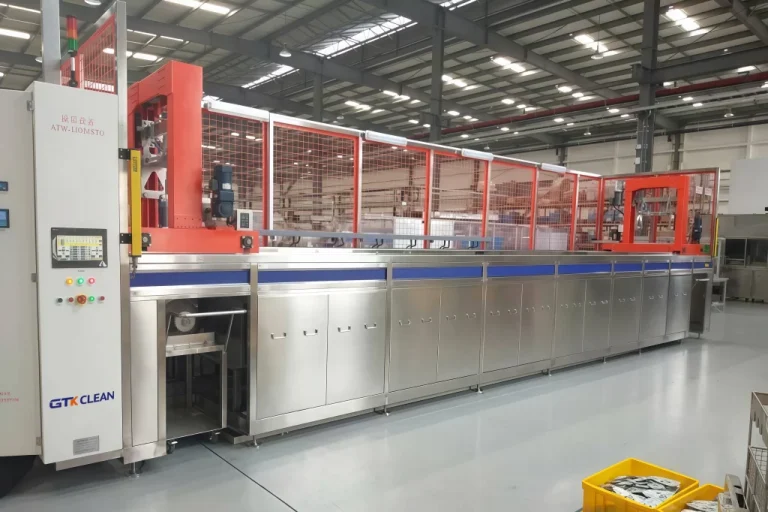
In production cleaning of die-cast aluminum shells, a common multi-stage sequence is spray degreasing, ultrasonic cleaning with an aluminum-compatible detergent, multi-stage water rinsing, and air-knife or hot-air drying. Oil-water separation and circulation filtration extend bath life and reduce detergent carryover. Cleaning temperature in such lines is typically held in a moderate range around 45–65 °C depending on the detergent, while rinse water is kept cooler to prevent flash staining.
Chemical selection works only when the cleaning system is matched to the part. <Choosing the Right Ultrasonic Cleaning System for Industrial Success> covers the tank, frequency, filtration, and process-control variables that produce repeatable aluminum cleaning results.
Ultrasonic Parameters That Clean Aluminum Without Pitting or Etching
Ultrasonic cleaning can protect or damage aluminum depending on frequency, power density, and exposure time. Low ultrasonic frequencies, such as 20–25 kHz, generate larger cavitation bubbles and more aggressive mechanical energy. They are effective for heavy soils on steel, but on soft aluminum they can produce cavitation erosion, especially on sharp edges and thin sections. Higher frequencies, such as 40–80 kHz, produce smaller bubbles and lower-impact cavitation. For many aluminum parts, 40 kHz or higher is the safer default when the goal is damage-free cleaning [2].
Power density should be high enough to clean but not so high that the part surface is hammered. Pulse or sweep operation reduces the likelihood of standing waves and hot spots that can concentrate energy on one area of the part. Degassing the bath before cleaning also helps stabilize cavitation and removes dissolved gas that can reduce cleaning consistency.
Temperature works together with chemistry. Raising temperature generally lowers solution viscosity, improves wetting, and accelerates soil removal, but it also accelerates chemical attack on aluminum. For aluminum-compatible detergents, moderate heat improves cleaning without excessive etch. Cycle time should be the shortest interval that meets the cleanliness requirement. Longer ultrasonic exposure is not automatically better because it increases the total energy delivered to the surface.
Frequency selection is one of the strongest damage-control levers for soft alloys. <Optimize Ultrasonic Frequency for Diverse Materials> covers the cavitation trade-off between heavy soil removal and surface preservation on aluminum and other sensitive substrates.
Before changing the line, record the current temperature, concentration, frequency, power, and cycle time, and run a controlled test on representative sample parts. If the process review is difficult, send part geometry, alloy, soil type, and target cleanliness to an equipment engineer for a matched basket-tank-frequency configuration. Email [email protected] for technical guidance.
Rinsing, Drying, and Corrosion Control After Cleaning
Damage after cleaning is often caused by poor rinsing or drying, not by the cleaning bath itself. Residual alkaline detergent left in blind holes or crevices continues reacting with aluminum after the part leaves the tank. Rinse water quality matters because hard-water minerals can dry as spots and initiate localized attack. Deionized or reverse-osmosis water is preferred for final rinsing on critical aluminum parts.
Parts should be oriented so water drains from blind holes, internal cavities, and threaded features. Air knives help remove bulk water from surfaces and recesses. Dryers should remove residual moisture quickly enough to prevent staining, but temperature should remain moderate on aluminum parts. High heat alone does not usually damage aluminum, but high heat combined with water and residual chemistry can accelerate local corrosion. A water-break-free surface after the final rinse is a simple and useful check for film-free cleanliness.
Basket Selection, Fixturing, and Load Placement
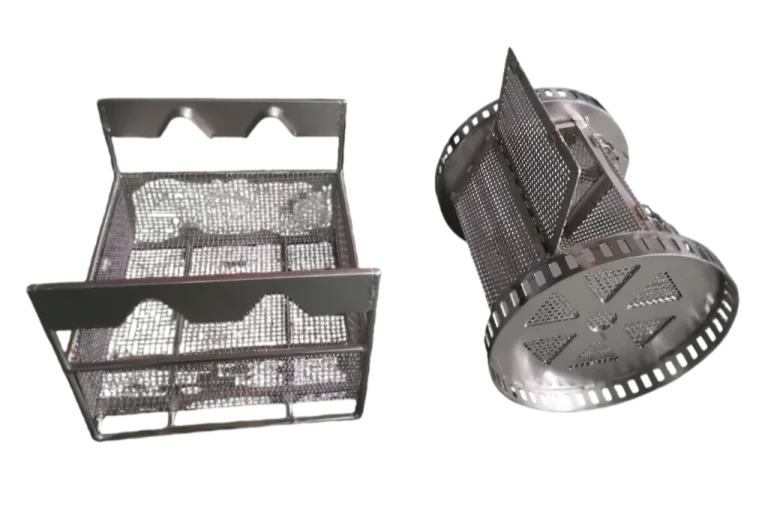
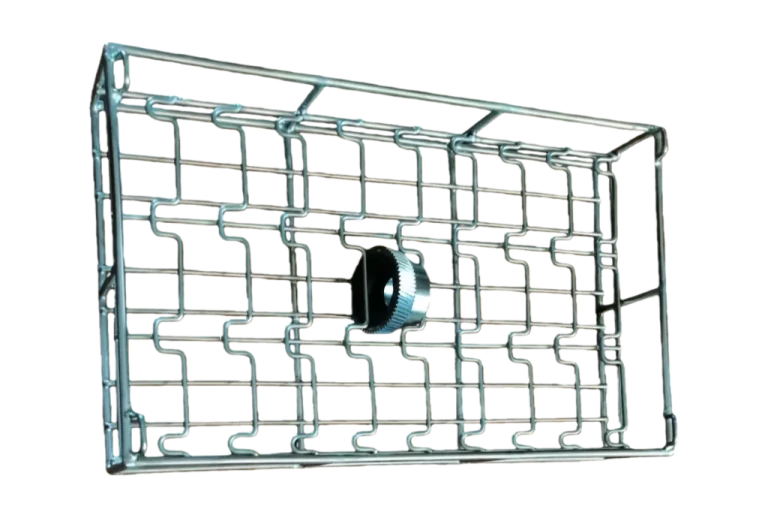
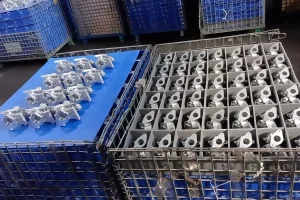
Aluminum parts are more susceptible to contact marks than hardened steel parts. Basket material, part spacing, and part orientation all influence whether ultrasonic energy cleans the part or rubs one part against another. Polymer-coated racks, plastic dividers, or lined stainless steel baskets can prevent aluminum-on-steel contact. Parts should be fixtured so they do not nest, stack, or trap air in blind cavities.
Basket design also controls drainage and cavitation access. A part that fills with air will not clean reliably in the trapped pocket, and a part that retains water or detergent will develop staining after drying. For complex parts with blind holes, rotary basket movement can help release trapped air and improve cleaning, rinsing, and draining. Heavy loads should be evaluated for part collision risk because ultrasonic agitation can cause small movements between adjacent components.
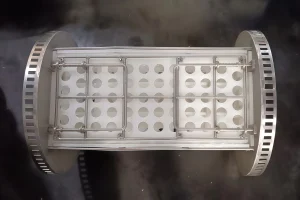
Contact marks and trapped liquid are common root causes of aluminum damage after cleaning. <Industrial Cleaning Basket Design: Optimizing Performance & Durability> covers fixture layout, drainage, and material choices for protecting soft metal surfaces during automated processing.
Process Verification and Common Failure Signs
A stable aluminum cleaning process should be verified on actual production parts, not only on generic test coupons. Inspection should look for pitting, white corrosion product, black smut, water spots, and loss of machined surface brightness. Rotate parts after cleaning to inspect blind holes, threads, and internal passages where residue can hide. For parts that will be anodized, plated, welded, or coated, the next process step is itself a useful detector: adhesion failures, visible etch, or blotchy conversion coating often point back to cleaning damage.
Process control should include cleaner concentration, pH, temperature, rinse quality, ultrasonic power settings, and basket loading. If damage appears only on one fixture or one lot, treat it as a process signal rather than a random event. The cause may be a changed detergent batch, a failed rinse spray, a basket overload, or a setpoint drift. When the process is changed, verify sample parts through downstream processing before releasing the change to full production.
Engineering Review: Validate Your Aluminum Cleaning Process Before You Scale
If the current cleaning line is producing stains, smut, adhesion failures, or micro-etching on aluminum, a controlled process review usually identifies the root cause faster than trial-and-error adjustments. An effective review should examine part geometry, alloy, soil type, cleaner chemistry, ultrasonic frequency and power, basket contact, rinse water quality, drying time, and the cleanliness target required by the next operation.
GTKCLEAN engineers can evaluate aluminum cleaning specifications and recommend a staged process that protects surface finish while meeting production throughput. Send part drawings, current cleaning parameters, photos of the defect, and target cleanliness to [email protected] or call +86 17768507147 for technical support.
FAQ
Can I use an alkaline degreaser on aluminum?
Yes, if the alkaline cleaner is specifically formulated and inhibited for aluminum. The critical controls are concentration, temperature, and contact time. A general-purpose steel degreaser with high caustic content is not usually safe for aluminum and can cause etching or black smut.
What ultrasonic frequency is safest for aluminum?
Higher ultrasonic frequencies, typically 40 kHz or higher, are generally safer for aluminum because they produce smaller cavitation bubbles and lower-intensity mechanical impact. Low-frequency cleaning can be used, but it requires tighter power and time control.
Why does aluminum turn black after cleaning?
Black or gray smut after cleaning usually comes from alkaline attack on the aluminum surface or from alloying elements such as copper or silicon left on the surface after soil removal. It can also result from residual cleaner reacting with the part. Mild acid desmut or inhibited chemistry may be required for some alloys, but the process must be validated.
Is it safe to put aluminum parts in a hot-air dryer?
Moderate hot-air drying is safe for aluminum if the parts are well rinsed and drained. The risk comes from high heat combined with trapped water and residual chemistry, which can accelerate localized staining or corrosion. Dryer temperature should be matched to part mass and water carryout.
Can I clean aluminum in a solvent ultrasonic system?
Yes, solvent cleaning can remove oils and greases without the water-based corrosion risk of an aqueous bath. However, solvent cleaning may not remove salts, fine abrasive particles, or many inorganic residues. The decision should be based on soil type, part geometry, downstream process, and drying requirements.
How do I know if the cleaning process is damaging the aluminum surface?
Look for pitting, white corrosion bloom, black smut, uneven matting, water spots, or loss of machined surface brightness. More reliable verification is to send cleaned sample parts through the next operation, such as anodizing, conversion coating, painting, or welding, and check for adhesion or appearance failures. If damage appears only on certain lots or fixtures, inspect chemistry, concentration, temperature, ultrasonic settings, basket condition, and rinse quality.
References
[1] ASTM B322-20, Standard Guide for Cleaning Metals Prior to Electroplating, ASTM International, 2020.
[2] ASM International, ASM Handbook Volume 5: Surface Engineering, 1994.
[3] S. Wernick, R. Pinner, and P. G. Sheasby, The Surface Treatment and Finishing of Aluminum and Its Alloys, 6th ed., ASM International, 2001.
If you’re interested, check out these related articles:
Eliminate Residue in Pre-Coating Parts Cleaning: An Expert Guide
Manual Ultrasonic Cleaning Machines: When to Use Them