Sweep vs Pulse Mode in Ultrasonic Generators: Key Differences and Selection Guide
Table of Contents
- What Sweep Mode Does in an Ultrasonic Generator
- What Pulse Mode Does in an Ultrasonic Generator
- How Sweep and Pulse Affect Cavitation and Cleaning Results
- How to Choose Sweep vs Pulse for Your Parts and Process
- Need a Baseline for Sweep and Pulse Settings?
- Talk to an Ultrasonic Cleaning Engineer
- Frequently Asked Questions
- What is the difference between sweep and pulse mode?
- Can sweep and pulse mode be used together?
- Does sweep mode change the ultrasonic frequency?
- Which mode is better for delicate parts?
- References
On many production cleaning lines, sweep and pulse are treated as secondary generator settings, but they often determine whether a basket of parts comes out uniform or requires rework. Sweep changes how the ultrasonic frequency is distributed across the tank, while pulse changes how often the ultrasonic field is applied. Each solves a different problem, and many industrial generators allow both to be active at the same time. Understanding the distinction helps you avoid changing chemistry or temperature when the real variable is the way acoustic energy is delivered to the part [1].
What Sweep Mode Does in an Ultrasonic Generator
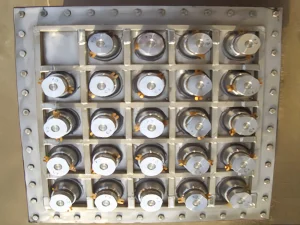
A fixed-frequency ultrasonic generator drives the tank transducers at a single selected frequency, such as 20 kHz, 40 kHz, or 80 kHz. At a fixed frequency, the sound field can form standing-wave patterns inside the tank: some zones experience high acoustic pressure while others sit in a low-energy dead zone. Parts in the high-energy bands may show cavitation erosion or visible marking, while parts in the dead zones remain contaminated [2].
Sweep mode—also called frequency sweep, sweep frequency, or frequency modulation—moves the generator frequency back and forth around the selected center frequency inside a controlled bandwidth. That continuous shift moves the standing-wave pattern, so no single part location stays under the same high-intensity node for the entire cycle. The result is a more even distribution of cavitation energy across the tank and basket [1][2].
Sweep does not change the base frequency. A 40 kHz sweep generator still produces 40 kHz-area cavitation; it simply varies the instantaneous frequency within a small window. If parts are being damaged or not cleaned, the first question is usually whether the selected base frequency is appropriate for the substrate, not whether sweep is on [1].
Sweep operates around a selected base frequency, so the base frequency still sets cavitation energy and substrate response. <How to Select the Frequency for Ultrasonic Cleaning Equipment ?> covers how 20 kHz, 40 kHz, and 80 kHz differ in bubble size, impact force, and part compatibility.
What Pulse Mode Does in an Ultrasonic Generator
Pulse mode leaves the frequency alone and cycles the ultrasonic drive on and off at a defined repetition rate or duty cycle. During the on interval, transducers build the cavitation field; during the off interval, the field collapses, dissolved gas can diffuse out of the liquid, and fresh cleaning solution can move back into blind holes and small gaps. Because the transducer is not driven continuously, average acoustic power and heat input are lower [3].
Pulse settings are normally expressed as on time, off time, or duty cycle. If a process uses 0.5 seconds on and 0.5 seconds off, the average ultrasonic power is roughly half that of continuous operation at the same amplitude. That does not reduce the instantaneous cavitation intensity during the on interval; it reduces the total energy delivered over time [3].
Pulse mode is especially useful for thin-walled parts, polished surfaces, coated components, and materials that are sensitive to cavitation erosion. The off period also allows liquid to replenish in recessed areas, which can improve consistency in blind holes compared with a continuous field that traps gas and debris [3].
How Sweep and Pulse Affect Cavitation and Cleaning Results
It helps to think of sweep as a spatial correction and pulse as a temporal correction. Sweep reduces the risk of the same part seeing persistent high-intensity cavitation at a single node. Pulse reduces the average energy input and creates repeated bursts of cavitation that can be easier to control for delicate parts [2][3].
| Parameter | Sweep Mode | Pulse Mode |
|---|---|---|
| Primary control | Instantaneous frequency around a selected center | Ultrasonic output on/off and duty cycle |
| Main effect | Moves standing-wave nodes; improves tank-wide uniformity | Reduces average power; controls heat and cavitation bursts |
| Typical use | Dense baskets, mixed geometries, banding marks, large tanks | Thin parts, polished surfaces, blind holes, coating-critical parts |
| Key variables | Center frequency, sweep bandwidth, sweep rate | On time, off time, duty cycle, repetition rate |
Sweep and pulse are not opposites. Many precision cleaning processes use both at once: sweep keeps the acoustic field evenly distributed, while pulse limits how much energy reaches fragile surfaces over the full cycle. The correct combination is process-specific and should be validated with foil erosion tests, particle counting, or a gravimetric cleanliness check, not copied from an unrelated line [4].
How to Choose Sweep vs Pulse for Your Parts and Process
Start with the failure mode. If parts come out with clean and dirty zones, visible banding, or erosion that follows a tank pattern, sweep is the first variable to evaluate. Dense baskets and mixed part geometries magnify standing-wave problems because the load changes the local acoustic impedance [2].
If parts are deformed, etched, or heated too much, or if thin-walled components fail under continuous cavitation, pulse mode is the first variable to evaluate. Reducing the effective duty cycle can preserve cleaning aggressiveness during the on window while lowering the total energy delivered per minute [3].
For most production loads, the practical starting point is a controlled baseline, not a single universal recipe. Run a foil test on representative parts, record sweep bandwidth, pulse on/off time, power, temperature, and chemistry batch, then change one variable at a time. This approach separates generator effects from detergent, temperature, and loading effects [4].
Generator modes are only one variable in a production cleaning line. <Choosing the Right Ultrasonic Cleaning System for Your Factory> covers tank configuration, material handling, and throughput requirements that affect repeatable cleaning results.
For coating-critical parts, the reason to choose pulse or sweep is often more about surface consistency than speed. Pre-PVD, pre-plating, and medical parts may tolerate little visible cavitation marking, so engineers tend to use sweep to prevent banding and pulse to control average energy [4].
Pulse mode is often used where part surfaces must stay defect-free before coating. <Ultrasonic Cleaning systems for Pre PVD (Coating) Parts> covers multi-stage cleaning, ultrapure water rinsing, and drying controls that prevent residue and water spots before PVD coating.
Need a Baseline for Sweep and Pulse Settings?
Baseline settings depend on the part geometry, base frequency, tank volume, basket design, and target cleanliness. If you are troubleshooting a current washing line or specifying a new one, send your part drawing, material, contamination, and current process parameters to [email protected]. A technical review can help define a starting sweep bandwidth, pulse duty cycle, and validation check for your specific parts.
Talk to an Ultrasonic Cleaning Engineer
Sweep and pulse settings are only as repeatable as the generator, tank, and process documentation behind them. If you need support with generator setup, process validation, or equipment selection, contact GTKCLEAN at [email protected] or +86 17768507147. Our engineers can help you build a traceable baseline for your cleaning line.
Frequently Asked Questions
What is the difference between sweep and pulse mode?
Sweep changes frequency around a center point to move standing-wave nodes. Pulse changes how often the ultrasonic output is turned on and off, reducing average power and creating controlled cavitation bursts.
Can sweep and pulse mode be used together?
Yes. Many industrial generators allow both settings at once. Combined operation can improve spatial uniformity while limiting total energy input, but the parameters should be validated on your specific parts.
Does sweep mode change the ultrasonic frequency?
It changes instantaneous frequency only within a configured bandwidth around the selected base frequency. It does not replace selecting the correct 20 kHz, 40 kHz, 80 kHz, or other base frequency for the part.
Which mode is better for delicate parts?
Pulse mode is usually the first choice because it reduces average acoustic energy and heat. Sweep can be added to prevent hot spots, but the duty cycle and amplitude should be established by testing on representative parts.
References
[1] ASTM G131-96(2016), Standard Practice for Cleaning of Materials by Ultrasonic Techniques, ASTM International, West Conshohocken, PA, USA, 2016.
[2] D. Ensminger and L. J. Bond, Ultrasonics: Fundamentals, Technologies, and Applications, 3rd ed. Boca Raton, FL, USA: CRC Press, 2011.
[3] T. J. Mason and J. P. Lorimer, Applied Sonochemistry: The Uses of Power Ultrasound in Chemistry and Processing. Weinheim, Germany: Wiley-VCH, 2002.
[4] F. J. Fuchs, “Ultrasonic cleaning: fundamental theory and application,” in Proc. 1995 Parts Cleaning Conf., 1995, pp. 1–18.
If you’re interested, check out these related articles:
How to Choose Between Aqueous and Solvent Cleaning Systems
How to Choose Cleaning Equipment for Medical Device Manufacturing